


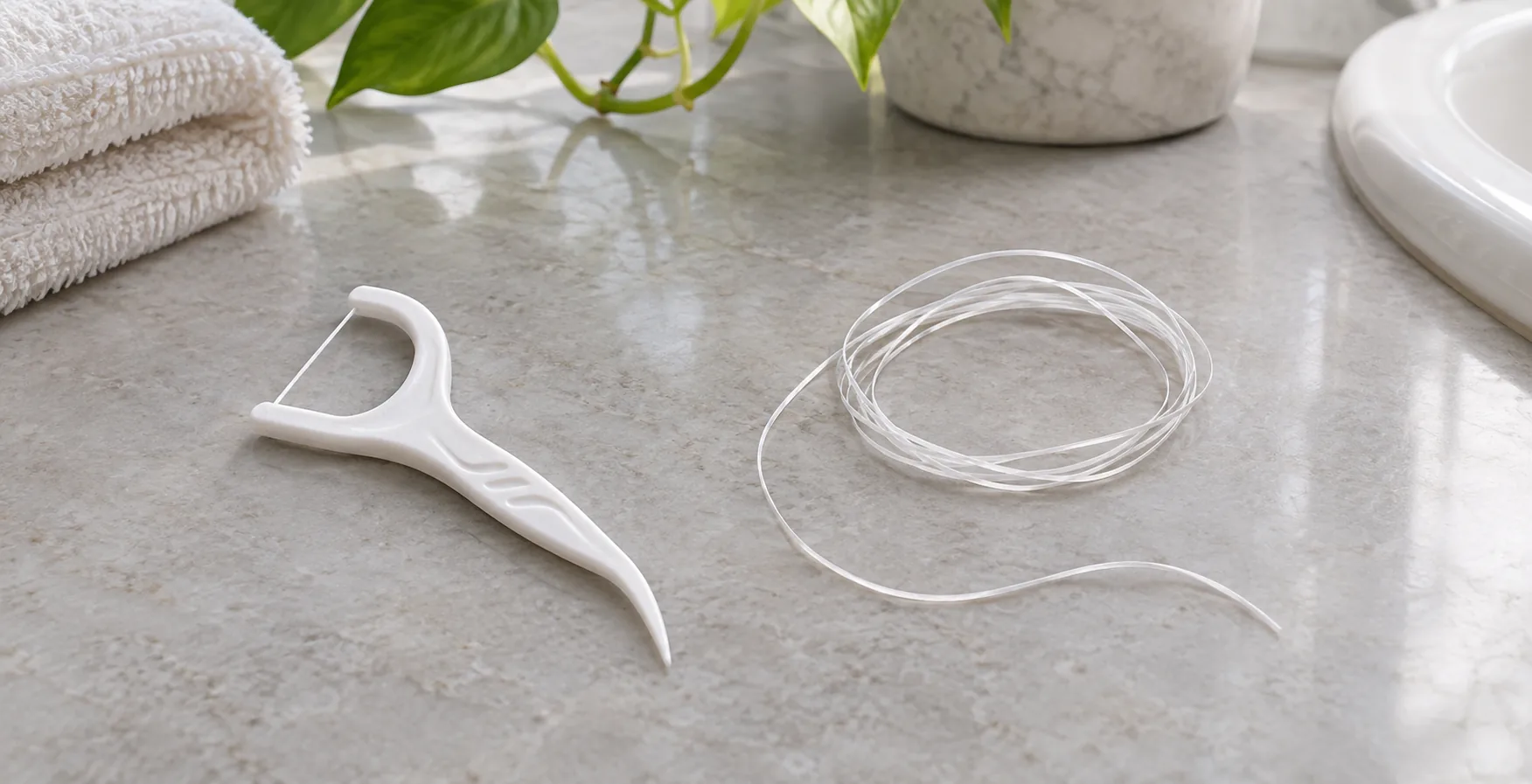
Floss picks vs string floss: both can help clean between teeth when used carefully every day. A floss pick may be easier to hold or reach with; a long piece of string floss offers more control for curving around each tooth. Neither is automatically best for everyone. The most useful tool is one you can use thoroughly and comfortably without injuring your gums.
By Dr. Manish Pandey, BDS, Dental Surgeon
Floss picks vs string floss: what is the practical difference?
String floss lets you move to a fresh section as you clean each space and curve the strand against each tooth surface. A floss pick holds a short, pre-threaded piece of floss in a handle. That can be convenient for people who find wrapping floss around their fingers difficult, but the fixed strand may be less flexible around some tooth shapes. The American Dental Association (ADA) includes floss picks among interdental-cleaning options and stresses that technique and regular use matter.
Can a floss pick clean as well as string floss?
A pick can be a useful alternative if you gently slide its floss between the teeth and clean the sides of both neighboring teeth, not just pop it in and out. That does not mean all pick designs perform identically or that a pick can reach every space in every mouth. Some products have earned the ADA Seal for plaque removal and gingivitis prevention when used as directed, but a seal for one product should not be generalized to every brand. Your dentist or hygienist can show you whether your chosen tool is reaching the areas that need cleaning.
How do you use either tool without hurting your gums?
Guide the floss gently through the contact rather than snapping it onto the gum. Clean along one tooth surface, then the other, with controlled up-and-down movements. With string floss, use a clean segment for the next space. With a pick, avoid pressing its pointed end into the gums. If a space is too tight or the floss shreds, do not force it; tell your dentist. The ADA advises cleaning between teeth without pain and choosing a device that fits the person.
When might another interdental cleaner be better?
Where there are wider spaces, gum recession, a bridge, braces or an implant, an interdental brush, threader or water flosser may be more suitable for some areas. A toothbrush cannot adequately clean tight spaces between teeth on its own. Ask your dental team to recommend the right tool and size for each space. Our guide to choosing interdental brush sizes covers wider gaps; our guide to flossing technique covers the basics.
How often should you clean between teeth?
The ADA recommends cleaning between teeth once a day, along with brushing twice a day with fluoride toothpaste. The timing is less important than doing it thoroughly and consistently. If using a pick makes the habit possible, that may be more helpful than owning string floss you never use. Discard used floss and single-use picks rather than trying to wash and reuse them; they may fray or carry debris from earlier use.
Common questions
Are floss picks safe for gums?
They can be when used gently and as directed. Pain, repeated bleeding or a pick that catches deserves a dental review rather than more force.
Does a floss pick replace brushing?
No. Brushing cleans accessible tooth surfaces; interdental cleaning targets the spaces a toothbrush misses. Both are parts of home care.
Should I switch tools if my gums bleed?
Not automatically. Bleeding can have several causes, including inflamed gums or overly forceful technique. Ask a dentist or hygienist to check persistent bleeding and demonstrate a suitable device.
References
- American Dental Association: Dental Floss and Interdental Cleaners
- ADA MouthHealthy: Flossing
- American Dental Association: Seal Acceptance Example for Floss Picks
Dental disclaimer: This article is general education, not a personal assessment. A dental professional can help you choose and use a cleaner suited to your teeth, restorations and gums.